




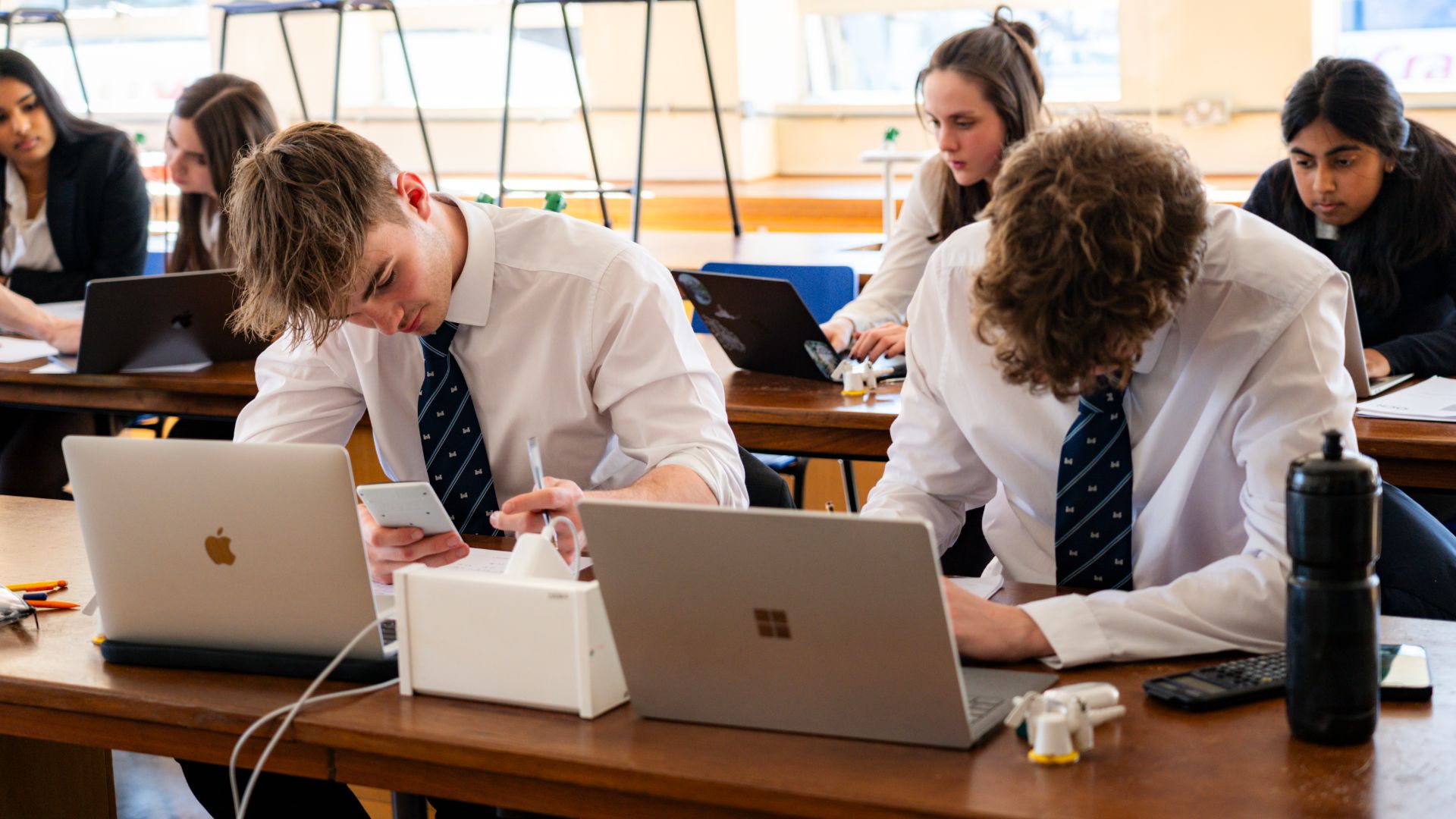
With expert teaching, a dynamic curriculum, and tailored support, our Sixth Form students are empowered to explore their passions and achieve their ambitions.
Each subject provides depth, analytical skill development, and real-world application, ensuring that students gain the knowledge and confidence to succeed beyond RGS.
Supporting Your Success
Choosing the right subjects is a crucial step toward shaping your future. At RGS, we guide students through their academic journey with expert advice, personalised support, and a rich learning environment that fosters independence and excellence.
Explore our Sixth Form curriculum, embrace new challenges, and take full advantage of the opportunities available at Reigate Grammar School.
The A Level course in Art and Design gives students the opportunity to explore their ideas through an incredibly broad range of materials, techniques and processes. Pupils are encouraged to push the boundaries of their art and to take risks with their work within a supportive and nurturing environment. The work produced is of the highest quality with pupils being ambitious with scale and adventurous with subject matter, informed by the work of other artists and embedded in the History of Art. The students work with given themes and are encouraged and supported to find the most suitable direction for their work, whether through painting, sculpture, printmaking, design or textiles. We believe that giving the pupils the opportunity to experience work first hand, at art galleries and museums, listening to artists speaking at conferences, taking part in life drawing classes and being responsible for displaying their own work at our major annual art exhibition as being intrinsic to their work and practice. A high proportion of our students go on to take up places on pre-degree foundation courses and art-related degree courses.
Biology is one of the most exciting and rapidly developing subjects. As well as being vital for future study of biological natural sciences and allied disciplines such as medicine, it plays a valuable part in the general education of any student with an interest in the natural world and humanity. Our course develops a detailed understanding of many core biological topics and explores a range of exciting new areas of research, including stem cells and epigenetics. Practical and investigative skills are an essential element of the A Level and they are developed throughout the course. We learn how to design valid investigations, research methods and outcomes, and present and critically analyse data. Students work towards the Practical Endorsement, a holistic assessment of students’ investigative skills which is excellent preparation for the experimental sciences at university. The ability to link topics and identify which aspects of the course address synoptic themes is a key skill which is developed throughout the course. The course is suitable for enthusiastic and hard-working students from a background of either Biology GCSE or a Double Award Science GCSE. Due to the broad syllabus, students must be well organised and prepared to commit time for independent study. Student suitability will be judged on an individual basis. A Level Biology will be an excellent preparation not only for degree courses in Medicine, Dentistry and Veterinary Science, but also for the Biological Sciences, Microbiology, Agriculture, Marine and Freshwater Ecology and many others.
Businesses help individuals develop new skills, innovate by designing new productos and services and create wealth in local, national and international communities. Business is at the core of the economy. With brands such as Apple’s net worth exceeding that of countries such as: Italy and Russia, it is easy to recognise the significance business plays in the world we live in today. Businesses are at the forefront of skill development, innovation and provide opportunities for employment and wealth in local, national, and international communities. Studying the Level 3 Business qualification provides learners with a comprehensive understanding of the key processes and functions of business, alongside the development of fundamental transferable skills e.g., presentation, research, and teamwork skills employers are seeking from today’s job market. Students taking similar Level 3 qualifications at RGS have gone on to higher education, receiving offers from universities such as Durham and Birmingham as well as other top 20 universities. The level 3 business qualification is assessed through a series of internal and external units. The course has a vocational stance; students gain enriched experiences through being placed in hypothetical contexts including working in roles such as: recruitment, events management, marketing consultancy and human resource management. Learners can study the qualification in multiple formats including the: L3 diploma in business, which is the equivalent of two A Levels, this will be supplemented by a further one or two A Levels (considered on an individual basis). Similarly, students can study the BTEC L3 extended diploma which is the equivalent of three A Levels and a full-time course.
Chemistry is essential to our modern society. Apart from the fascination of understanding how things around (and inside) us work at the molecular level, chemistry affects every one of us, every day of our lives. Some people regard chemistry as a dirty, non-green subject. They are quite wrong! The reality is that if you wish to do something about, for example, environmental pollution, a thorough understanding of chemistry is essential. Today’s chemists are at the forefront in helping to control, reduce and avoid pollution. If you enjoy the interaction of atoms and molecules, along with the bangs, the colours, the smells, and making new substances then A Level Chemistry should appeal to you. The course is demanding and complements subjects such as Biology, Physics, Maths and Geography. If you study A-level Chemistry then you should be able to ask “Why?” and get a good answer. You will learn how to explain chemical ideas with both words and mathematical concepts. We are proud of the number of our students who go on to study Chemistry at university. A-level Chemistry is particularly important if you want to study Medicine, Veterinary Science or Biochemistry at university. It is also highly regarded by admissions tutors in many other subjects, including Law, due to its demands for logical thinking. It is also useful if you want to go on to study subjects such as Geology, Physical Geography, Engineering, or Material Science. Job prospects are excellent in all of areas of Chemistry. In addition, the ability of Chemistry graduates to solve problems using logical thinking, data analysis and to carry out research means they are valuable in all types of employment and are sought after by a wide range of industrial, environmental and financial companies. Our teaching sets are small and lessons are dynamic. There is an emphasis on practical work and students are expected to contribute fully to lively discussions. A comprehensive system of tutorials affords our A level students the opportunity to think independently and we urge all year groups to make good use of our extensive departmental library. National competitions, both pra
(Latin, Greek and Classical Civilisation) Classics is the study of a complete civilisation – from political theory to literature, from history to art – and as such it is a highly-regarded way of demonstrating all-round academic and applied ability. Whilst fascinating in their own right, Classical subjects are also an ideal complement to a host of other options. An A Level in a classical subject does not necessarily mean Classics at university and many students go on to read Mathematics, Engineering, Natural Sciences, Law, Music, Modern Languages to name just a few of the routes open to Classicists. Latin and Greek Both language and literature are studied. Set texts are studied with a combination of prose and verse, as at GCSE level. Language work continues to support the understanding of the literature and subsequently the discussion of its qualities and style. Students enjoy reading ‘real’ Latin or Greek, not heavily adapted as at GCSE. In Latin, we usually read a portion of epic poetry and a historian or orator. In Greek, it is usually Oratory or History, and Homer, followed by a tragedy or comedy. Classical Civilization Classical Civilisation is a natural progression from GCSE level, but those with no prior knowledge of the subject are at no disadvantage, and there is no Latin or Greek language element to the course. Topics studied are dramatic and fascinating, and together give a broad overview of the ancient world. Topics include Homeric epic, Greek art and the politics of the late Roman republic. If you haven’t taken the subject before it is preferable to have high levels of literary and evaluation skills (such as are found in English and History) to be successful in the A Level course. Full details of all courses are detailed in the A Level course guide Please follow our Twitter feed @ClassicsRGS for the latest updates
Computer Science is rapidly changing every aspect of the world we all live in. The best way to predict the future is to implement it.— David Heinemeier Hansson When our students leave university and look for their first job, many of them will be applying for roles that do not yet exist. A rounded education should help prepare them for this constantly evolving world. Studying Computer Science teaches students a range of invaluable life skills such as reasoning, logical thinking, problem solving, precision and resourcefulness. The A Level course helps students understand the core academic principles of computer science. Classroom learning is transferred into creating real-world systems through the creation of an independent programming project. This will develop the student’s technical understanding and their ability to analyse and solve problems using computational thinking. We are a small friendly department with a strong emphasis on offering a range of enrichment opportunities which include: Participation in a wide variety of national challenges and competitions e.g. the UK Bebras Computing Challenge, the TCS Oxford Computing Challenge, Alan Turing Cryptography competition, VEX IQ Robotics and the British Algorithmics Olympiad. Trips to the Wired Next Generation conference, National Museum of Computing, Bletchley Park and the Computing LIVE conference. Opportunities to enthuse younger students about computing through volunteering and leading weekly clubs and activities. Opportunities for university entrance are excellent and every year students of Computer Science have been accepted at top universities (including Oxford, Durham and Southampton). Computer Science at A Level is both challenging and rewarding, offering a wide range of experience and the invaluable development of problem-solving skills.
Apart from being accepted as an entry qualification for a vast range of arts, social science and humanities courses at degree level, Drama and Theatre is also recognised as an academic A Level by major universities, including Oxford and Cambridge. Furthermore, the social and communication skills developed as an integral part of the course are invaluable to ‘life after school’: whether you choose an academic, artistic, commercial or industrial career. The course will greatly enhance your cultural experience and provide you with a whole range of personal and group disciplines. In addition, by insisting on informed, accurate and critical analysis in all academic work, the course develops and deepens your intellectual abilities. The course demands a high level of analytical and evaluative skills and a huge amount of independent learning. It is, of course, hugely enjoyable! The Drama and Theatre course illustrates how drama and theatre have always been related to the historical and social contexts and both of these reflect and influence the manners, politics and attitudes which have been responsible for its birth. To establish the contexts, it is necessary to study the genres, fashions, philosophical movements, legislation, changing audiences and new artistic and scientific developments which provoke theatrical change. The course is not and cannot be an actor’s training course, designed simply to provide candidates with a showcase for their talent; very few do have the talent and determination to follow such a career. However, the advantages and benefits of an A Level in Drama and Theatre goes far beyond the merely vocational; the value lies in the challenges and rewards that it offers of itself. The examination is a combination of practical assessment with evaluative elements and a written paper. Studying the course demands the exploration of texts from a range of periods: Greek, Elizabethan, Restoration, Early Realism, Modern British, American and European Drama. It also requires practical exploration of a range of styles: naturalism, physical theatre, expressionism, dance, commedia and high comedy. Texts will be studied in the context of relevant theatrical conventions and styles. We shall look at the impact of twentieth century practitioners such as Stanislavski, Brecht, Artaud, Grotowski and Berkoff. Their influence on contemporary drama will support the practical work undertaken. You will have to perform both devised and scripted work as part of A Level Drama and Theatre. It is advisable to have taken the subject at GCSE and the following skills are needed to do well in the subject: be a confident and able performer; be critically perceptive; be curious; read widely; go to the theatre; write fluently; enjoy working both collaboratively and independently and have a good understanding of stagecraft. Please visit the Drama and Theatre Arts website for further information on the myriad of extra-curricular opportunities available. Follow our Twitter feed @RGSDrama for the latest update
We make economic decisions every day, even though most people don't realise it. How do I decide between the cinema and watching my favourite team, going for a run or reading an article in the Economist, as these represent conflicting choices concerning my time and money? I am forced to decide which of my wants is most important. That’s the whole idea behind economic decisions; there are not enough resources available to the world to satisfy everyone’s wants. As economists, we attempt to understand the decisions that are made and analyse their impact on individuals, firms and society as a whole. At RGS we attempt to provide a framework for students to make sense of the world around them, develop an understanding of current economic issues, problems and institutions that affect everyday life. In short, students learn to analyse, explain and evaluate the strengths and weaknesses of the market economy and the role of the government within it. At A Level, students do not have to deal with complicated mathematics but they must be able to think logically and in the abstract. Students also require a clear mind and an ability to think logically. Strong GCSE grades are required in both Maths and English to undertake this course. The most successful students must also have an interest in current affairs. It should be noted, however, that most UK universities either require, or strongly prefer, Economics applicants to have studied A Level Maths. We enjoy regular department activities, like our film night to watch The Big Short. We take advantage of our proximity to the financial hub of London in our annual trip to visit the Bank of England Museum and take a walking tour of the financial district with representatives from the LIBF. Those with a passion for Economics and other social sciences are welcome at the Anthropos society, which meets weekly and where students present on topics of interest, debate and enjoy the chance to hear from their peers about the different perspectives across subjects. A range of visiting speakers add further opportunities for our economists, including former students studying Economics at university and working at the Bank of England, as well as entrepreneurs like the founders of Griddle and the CEO of Wagamama. We encourage our students to develop their understanding of the subject by entering external essay competitions, for example the Royal Economics Society (RES) and Institute of Economic Affairs (IEA), attend public lectures at LSE and students have also visited Eton College to take advantage of their speaker programme. All students have free access to the digital Financial Times, copies of The Economist and other Economic periodicals relevant to the subject.
A Level English Literature is an incredible opportunity to delve into the world of reading, words and debate. Drama, conflict, love and tension: the whole human condition is under scrutiny at every turn on our A Level course. You will have the unique chance to engage with an array of powerful texts which will challenge your perceptions of the world around you whilst offering you the chance to exercise a sharp, inquisitive and critical mind. You will be encouraged to develop your own critical positions and to make your own choices about tasks and texts for the coursework module too. Your reading will not only take you on a journey through prose, poetry and drama: you will also engage with challenging accounts which illustrate the world the writers were living in and take in a broad range of critical essays and writing. Across the course, you will study a variety of set texts which cover poetry and drama. Poets such as Sylvia Plath, Ted Hughes and John Donne are considered against a vibrant range of contextual and critical viewpoints. For drama, plays such as The Duchess of Malfi and A Streetcar Named Desire are contrasted, whilst a Shakespeare text such as King Lear is analysed through the backdrop of Jacobean politics. We also make sure that you can see drama in performance and look for the best of London’s theatre scene to enrich the study of plays in performance. The coursework module allows you to choose a pre-2000 text to compare with something more contemporary such as Cormac McCarthy’s The Road. Students have previously worked on investigations covering the presentation of religion, dystopian landscapes and the role of women; where you take the essay is up to you. Alongside the set texts you will cover a plethora of poetry and prose in preparation for the unseen module. Writers from the late Victorian era and the Modernist era including Oscar Wilde, EM Forster, Thomas Hardy, Virginia Woolf and DH Lawrence are analysed against aspects of their society which influenced their writing. For poetry we look across the whole spectrum of English Literature from Chaucer to more modern writers like Dan Gerber. It is vital that you should enjoy reading if you would like to study English Literature; intellectual curiosity and a desire to see new perspectives are both desirable and sharpened during the course by your teachers, your reading and visiting speakers. Not surprisingly, English Literature is an excellent preparation for any student whose university subject or future career will involve analytical skills and coherent writing. Please follow our Twitter feed @RGSEnglish for the latest updates
People are now pursuing their careers all over the world and thus the ability to communicate in a foreign language and to appreciate other cultures is very important. At Reigate Grammar School A Level French is studied by students of every discipline. There is scope and choice for study in all areas of interest from European politics to French art, drama and literature, media and environmental issues. Considerable emphasis is laid on speaking skills and understanding what is heard in French. The multi-media language learning centre ensures immediate access to worldwide sources, interactive communication and all the developing advantages of language laboratory teaching. There is weekly conversation practice with the Foreign Language assistant and a weekly French lunch where staff and pupils can enjoy informal conversations in French. Trips to French courses or theatre performances are organised to complement the syllabus and widen the students’ exposure to the language and culture. We give our Sixth Form students opportunities to enthuse younger pupils about languages through volunteering and leading weekly clubs and activities at Reigate Grammar. The A Level course is a natural sequel to GCSE and is accessible to students who performed well at that level. It includes the practice and testing of the skills of listening, reading, speaking, essay writing along with translations into both French and English. Detailed course content is available in the A Level course guide. Opportunities for university entrance are good and a number of students of French have been accepted at top universities (including Oxbridge) in recent years. In addition to dedicated language courses at university, there are many joint courses which combine languages with other disciplines such as Law, Marketing, Management, Drama and Art. French at A Level is both challenging and rewarding, offering a wide range of experience and the invaluable development of social skills.
Geography in the Sixth Form will help you to develop a diverse range of skills, including communication, numeracy, graphicacy, problem solving, team work and critical thinking. The course is relevant to the real world and addresses contemporary issues. These elements help to build a solid foundation for the move into further education and indeed the workplace beyond. The nature of peoples’ working lives is changing and the development of a wider perspective and transferable skills learnt in Geography provides a firm base for life-long learning. Statistics show that Geography graduates rank extremely high in employment tables. Geography offers an ideal link between science and art choices, and is favoured by a number of leading universities. A significant number continue with the subject at university; recent courses chosen include straight Geography, Geography and Planning, Geography and Oceanography, Geography and Sports Studies, Geography and Sociology, Geology and Geomatics. Others have used it to support applications for courses including Psychology, Medicine, Land Economy, Environmental Science and Environmental Law. It is accepted as both a humanity and a science subject by many universities. Teachers have the opportunity to follow their particular subject specialisms at Sixth Form Level, with the teaching broadly divided into human and physical topics. Fieldwork is a compulsory element of the course to allow for a piece of independent research. Recent destinations visited include Norway, Reigate, Brixton, Spitalfields, Box Hill, Camber and Gatwick. Students are encouraged to engage in activities beyond the classroom, including fortnightly meetings of the Geography Society. Talks are often provided by students and occasionally outside speakers; recent sessions have covered diverse topics such as climate change, urban architecture, plastic in the ocean and ethical sourcing of food. Students who have enjoyed the GCSE course and show an interest in the world will love the challenges of this exciting A Level course. Please follow our Twitter feed @GeographyRGS for the latest updates.
The German course aims at A Level to extend the four GCSE skills – reading, speaking, listening and writing. Furthermore, students will have the opportunity to study one film and one literary text in detail but the programme allows much freedom of choice for independent study. The A Level German course reflects the issues of the contemporary world, e.g. aspects of German-speaking society, artistic culture in the German-speaking world, multiculturalism aspects of political life in the German-speaking world. Over two years of study, the programme helps students to develop their general study skills, and, above all, aims at enabling them to communicate at a higher level in German. The course covers a wide range of topics relevant to German-speaking society, full details are available in the A Level course guide. All candidates are offered weekly speaking tutorials, on an individual basis or in very small groups, with the school’s native speaker assistant. Research of German language areas of the internet is positively encouraged, with the multi-media language laboratory offering a variety of further opportunities. Visits and exchanges are arranged as required, often on an individual basis to suit particular students, and the precise format of these may therefore vary. Opportunities for university entrance in the current climate are excellent; the number of courses combining German and other disciplines is growing all the time. Virtually all the department’s students proceed to university level studies in many different subjects; former students who have graduated have entered fields as diverse as teaching, finance and the Royal Navy. The course will suit those who have genuinely enjoyed their GCSE studies, who have acquired in the process sound fundamental grammar and are willing to travel to use their German in the countries where it is spoken.
History is vital to our understanding of the world around us and the forces that shape the present and the future. At A Level, History seeks to answer such significant questions as: What causes civil wars and revolutions? How can individuals come to dominate their own and other countries? What forces bring about fundamental changes in society and politics? To what extent and why have the causes and nature of warfare changed over time? Why do some groups have to struggle to achieve equal rights? History does this through the study of particular events, individuals and developments in British, European and American History. The prime focus at A Level is on explanation, evaluation and analysis. The study of history aims not only to increase your knowledge and understanding of the key factors that have shaped our world but also to cultivate your ability to think critically, produce coherent and compelling arguments, to research effectively and communicate clearly. That is why History A Level is so highly regarded by both top universities and employers and is considered relevant for a wide range of career paths, from the City to the Cabinet, top management to the diplomatic corps and law to journalism. Teaching and learning are varied and will help you to develop key skills. There is a student led History and Politics society, and a weekly History and Politics reading group. There are visits to conferences and exhibitions, and a biannual study visit abroad. Recent destinations have included Moscow and St. Petersburg, New York and Washington. You do not have to have studied History at GCSE to study it at A Level, but it is a distinct advantage to have done so. It is also important to write well and to enjoy reading, discussion and argument. Please follow our Twitter feed @History_RGS for the latest updates
Mathematics is a vital tool in our increasingly technical world. It provides us with the ability to problem solve, to recognise patterns and teaches us how to think logically. It plays an important role in many aspects of modern life, from protecting our details online to predicting the next stock market crash. As Mathematics has such a wide variety of important applications, there is a constant demand for well-trained mathematicians in a wide range of jobs. These can range from computer programmers, aircraft designers, statisticians, meteorologists, company manages, actuaries, engineers, accountants, teachers to researchers discovering the mathematics behind the next revolutionary piece of technology. A Level Mathematics A Level Mathematics consists of Pure Mathematics, Statistics and Mechanics. Students who wish to embark on this course will need to have competent algebra skills and have the confidence to use the techniques learnt at GCSE. They should be able to work on their own and have the ability to apply given knowledge to a variety of problems. For these reasons, we strongly advise that A level mathematics should have achieved a grade 8 or 9 in their IGCSE exam. A Level Further Mathematics A Level Further Mathematics must be studied in conjunction with A Level Mathematics and will therefore count as a 4th A Level option. In addition to content studied in A Level Mathematics, students will also study a combination of Core Pure, Further Pure, Further Mechanics and Decision Mathematics. Due to the challenging nature of this course, we strongly advise that students should have achieved a grade 9 in their IGCSE exam, as well as a grade 8 or 9 in their Further Maths GCSE (if offered by your school). Full details are available in the A Level course guide
Sixth Form music students benefit from full access to the excellent facilities available in the Music School. Music is a diverse subject and is highly regarded as producing students who are not only creative and confident but who can also analyse and write with insight. Sixth Form music students can expect to study music as a practical, creative and intellectual subject and will learn to perform, compose and appraise. The areas of study recognise the diverse cultural age we live in and cover music from classical, jazz, popular and world genres. Each area of study is seen within a broad cultural and historical context, and students gain in-depth experience of specific musical elements, resources, procedures, qualities and repertoire. In a competitive world a creative arts qualification is invaluable; students with Music A level will be just as likely to move into any career as they are likely to move into a musical one. Past students have gone on to degree courses not only in music, but also in wide variety of arts, medicine, science and technology subjects. This course is suitable for all students who have a keen interest in many kinds of music, and are proficient in an instrument. Each individual brings different skills to the course – please speak to the Music department to explore what the course may have to offer you. Music scholarships are available for students entering the school at 11+, 13+ and 16+, further information is available on our Scholarships page The extra-curricular opportunities on offer are plentiful, please take a look at the Music page for more details and follow our Twitter feed @rgs_music for the latest updates.
The A Level course encourages independence of mind and allows students to develop, refine and communicate their own ideas through photography. The students are introduced to photography using both analogue and digital technology. The course is based around themed projects, where students are encouraged to advance their own ideas. Work produced is highly personal and develops according to each student’s interest and engagement with the chosen themes. They are encouraged to explore different photographic movements and genres using traditional and contemporary techniques to develop their own individual style. Classes are small enough to allow the teaching to be tailored to each student’s particular interests and to support them with pursuing their creative ideas. The students carry out in-depth research and critical analysis of other photographers, designers and artists to contextualise their own projects. Students have access to a broad range of techniques and specialist equipment including a chemical dark room, a photographic studio and digital editing while being supported by a specialist teacher. Examples of A Level work is on display in the Wright Gallery and is included in the Summer Exhibition.
(BTEC) Sport is an ever developing subject area and this is reflected in the breadth of the courses on offer. Students are given the opportunity to explore their own interests through the choice of either an A Level in Physical Education or the Sport BTEC qualification. Both courses run for the two years of the Sixth Form but whereas the A Level is assessed largely by final examinations, the BTEC course is more vocational in nature and leads to the National Extended Diploma in Sport. BTEC students will usually study another A Level alongside the BTEC course. Full details of both courses are available in the A Level course guide A Level This course is a good choice for students wishing to study Sports Science at university but it also offers a gateway to degree subjects such as Psychology, Physiotherapy or Science. Not only does the course teach the scientific disciplines required (eg Physiology, Biomechanics etc) but it will also introduce students to the development of the sporting industry and the issues currently facing the world of sport. Opportunities will exist to analyse a student’s own playing performance and they will learn strategies to improve both physically and mentally. Students will be taught by three specialist teachers and will enjoy a wide range of extra-curricular opportunities such as lectures on nutrition in sport, trips to sporting venues of interest and visiting guest speakers. BTEC Students opting for the BTEC course will benefit from gaining employability skills alongside academic study. Problem-solving, intra and inter-personal skills feature highly in this course in addition to the ability to read technical texts, analyse and write effectively. Students will be able to select areas of interest from a range of units available. A BTEC is equivalent in size to three A Levels. At RGS, Sport (BTEC) students will usually take another A Level in addition to the BTEC course Please speak to the Head of Academic PE if you would like to discuss which course would be most suitable for you. Extra-curricular sport is a key feature of life at RGS including the opportunity to travel on tours – please see the Sport page for further information. Please follow our Twitter feed @RGSSport for the latest updates
Physics is a vital, exciting and compelling subject in this technological age. It develops our students’ abilities to critically analyse scientific studies and technological developments in an ever-changing world. The subject stimulates and excites curiosity about phenomena and events in the world; satisfying this curiosity with knowledge and understanding. Physics can engage students at many levels and is a spur to critical and creative thought. Through science, and Physics in particular, candidates understand how major scientific ideas contribute to technological change – impacting on industry, business and medicine – improving the quality of life. Our A Level Physics course has a reputation for its practical emphasis, as well as its attention to scientific rigor. Physics A Level is highly regarded by all universities. At university our pupils use Physics to go on to study aspects of science, engineering, electronics and medical studies as well as many non-scientific courses such as Management, Architecture and Law. The syllabus is substantial and practical work runs throughout the A Level course. This is a linear course and is assessed at the end of the second year. A pupil who decides to take on the challenge of A Level Physics should be prepared to supplement their lessons with plenty of independent learning, particularly reading popular science books and journals, lists of which can be obtained before the start of the summer holidays. Historically, successful pupils have chosen Physics as part of a cohesive group of subjects and have worked hard right from the first half of the Autumn term in the first year. Physics A Level is both challenging and exciting and can be combined with a wide range of other subjects which would usually include A Level Mathematics and Chemistry, although this is not essential.
The thing to remember about the will of the people is, it isn’t that long since we were swept away by the Macarena How much do I need to know about Politics before studying it? The course assumes no prior knowledge, simply an interest in the subject and a willingness to work and keep an eye on contemporary developments. It is important that you read a good newspaper and enjoy watching relevant TV news programmes, as well as checking out publications such as The Spectator or The Economist. In order to do well in Politics, students must enjoy thinking creatively both orally and on paper and keep up to date on current affairs. Key recent topics Brexit Climate change protests The 2019 General Election Devolution The power of the Supreme Court The election of Donald Trump in the USA The power of Congress in the USA Key skills Construction of argument, independent learning, political analysis, extra-curricular and extra-mural opportunities: Trip to Washington/New York; Westminster; TV stations; guest speakers – local and national politicians of major political parties and commentators. Previously, politics students have spoken on radio programmes, hosted public meetings, visited Channel 4 and completed work experience for major political parties. What choices will an A Level in Politics give me at university and beyond? A foundation in Politics would be an advantage in careers in journalism, law, lobbying, finance and civil service. The A Level course teaches students to think critically and write persuasively and these skills are recognised and rewarded by employers. Typically students would require GCSE Level 8 or above in English, History or Geography to be successful in A Level Politics. Weekly extra curricular opportunities include the ability to debate in Model United Nations (MUN) and involvement in the History and Politics society. Please follow our Twitter feed @Mostlypols for the latest updates
Design and Technology is a vast subject area and this is reflected in the breadth of this Product Design course. Students are given the opportunity to explore their own interests in all areas of design through the taught curriculum and their own self-directed study. They will develop their skills and knowledge of materials, processes and techniques in theory and in practice. What is Product Design? In every part of your life you are surrounded by products that have been designed and made. In this consumer society it is impossible to escape the impact of Product Design. During the course students will be encouraged to develop critical thinking and to observe relationships with the designer, the manufacturer, the user and the world. Research and development are vital parts of the design process and will support the making of quality products. Which careers could I go into with A Level Product Design? Engineering, Architecture, IT, Advertising, Film, Interior design, Fashion Design, Graphic Design, Furniture Design, Marketing and many more. Those with other interests and aspirations would benefit from the transferable skills inherent in the course including problem solving, IT, communication, team work and independent learning. Expectations Over the 2 year course you will be expected to maintain high standards in both your practical and theory based units. This course is ideal for creative, innovative and committed students. A GCSE in Design & Technology is preferable but the course would also be suitable for students that can demonstrate a clear commitment to the subject. Full course details are available in the A Level course guide
The sciences are amongst the most popular and successful subjects at Reigate Grammar School. Psychology is the scientific study of the mind and behavior. It utilises a variety of skills (description, application and evaluation) all of which combine to teach students to consider a wide variety of behaviours and critically evaluate these. Studying Psychology opens a wealth of opportunities at university and in the wider world. Students will learn to plan, conduct and evaluate psychological research and experiments. In addition, students will explore areas such as early psychopathology, social psychology, gender development and memory and forgetting. Students are strongly encouraged to engage in wider reading to stretch their understanding. They will also have the opportunity of listening to key speakers in the subject to further their interest. Extra-curricular opportunities include lectures at Royal Holloway University, guest speakers in Biopsychology and the opportunity to explore London on foot to consider the history of mental health diagnosis and treatment. A weekly Psychology society meeting, alongside Economics and Theology and Philosophy enhances the curriculum and offers students the opportunity to discuss current topics and consider multiple viewpoints.
The ability to communicate in another language will be a key factor for success in the career market of the 21st Century. As a major European language, Spanish will give students a clear practical advantage in terms of job opportunities. The study of Spanish is no longer limited to the study of literary texts, but focuses on the need to achieve oral fluency and communicate effectively. A command of the language will open the way to career success in many areas of employment – industry, banking, international law and foreign accountancy, to name but a few. Spanish combines well with other A Level subjects, including Sciences, Mathematics and the Arts. In addition to studying pure Spanish at university, there are many exciting degree courses that allow a combination of Spanish and other subjects such as Business or Law. The course is modern and practical. Lessons will enable you to reach a good level of fluency and develop your capacity for critical thinking through the vibrant medium of Hispanic culture. You will engage intellectually with stimulating materials, including song, film and text, developing an appreciation of the language in its cultural and social context. Students will have a weekly individual oral session with a Spanish Assistant and regular use of the Language Laboratory is a prominent feature of the course. There is the option to take part in a Sixth Form trip or complete work experience abroad. There are also regular theatre, cinema and museum trips. Within the Languages Department there are numerous leadership opportunities available such as helping at Junior Culture Club. To achieve success in this subject students are likely to be good communicators who have an interest in language, other countries, their people and customs.
The Theology and Philosophy course is an invaluable opportunity to gain transferable skills for careers and courses demanding analysis, evaluation and clarity of expression. This A Level course is aimed at those who are prepared for an open-minded exploration of the big questions, in particular the medical, legal and moral issues that affect the lives of humans today, as well as deeper philosophical questions about the nature of the universe and of humanity, and the existence or non-existence of God. The course is designed for anyone to undertake and previous knowledge from GCSE, whilst helpful, is not a requirement (those without GCSE background can easily get up to speed with a little summer reading). An open mind to often controversial and complex issues is required, as is the understanding that we are required more often than not to discover the questions and a number of solutions, but not a definitive answer. Those who wish to ask the impossible questions about life, the world and the universe and explore some of the answers offered by the philosophers and scholars are likely to feel at home being challenged by and challenging others on this course. An A Level in Theology and Philosophy is a highly regarded qualification for anyone proceeding to university in both the arts and the sciences. The ability to think clearly and to evaluate contrasting philosophical, ethical and moral views, as well as possession of an understanding of the history of ideas from Socrates onwards, are valued by both universities and employers. Those studying A Level in the past have gone on to study in such diverse fields as PPE and Law at Oxford and Cambridge, Medicine at University College London, English at Durham, History at St Andrew’s, Journalism at Bristol and Sports Science at Loughborough – as well as Theology and Philosophy at all of the above! The big issues in areas such as legal ethics, medical ethics and the environment as well as sex and relationships provide the opportunity to explore what has been traditionally seen as right and wrong and how we apply these ideas in practice. Big questions such as “if there’s a God why doesn’t (s)he prove it?” in addition to euthanasia, cloning, IVF and social justice are investigated through the writings of the philosophers and scholars, always requiring pupils to evaluate for themselves the relative strengths and weaknesses of the contrasting evidence.