




Guided by dedicated educators and bolstered by a tradition of pastoral support, every subject at RGS is a stepping stone to excellence, ensuring that students not only achieve academically but also discover the subjects that truly resonate with them.
GCSE Course Choices
Embrace the opportunity to shape your future with a curriculum that celebrates excellence, creativity, and individuality.
Art is distinctive in the way that it enables us to combine feeling, thinking and making. Art and Design makes a unique and significant contribution to school life and to the learning experience of all students. Art is all encompassing and all pupils have the opportunity to explore different ways of expressing ideas, experimenting with a broad range of materials, techniques and processes and develop an awareness of their visual world and the cultures that have shaped it. The Art department at Reigate Grammar School has a strong reputation for the quality of its work and for the broad range of disciplines it offers its students. Those disciplines offered at present are painting and drawing, printmaking, sculpture, photography, ceramics and textiles. The department believes that pupils should be able to become independent learners, and that they should feel able to take risks with their work within a supportive and nurturing environment. The department benefits from purpose-built accommodation, constructed in 1995, which consists of three main studio areas, a darkroom and sixth form studio. Students’ work is displayed around the school, especially in the main entrance hall and Wright Gallery. Pupils from all year groups have the opportunity to exhibit their work in the annual Art Exhibition and opportunities are also often taken up to exhibit work outside school, for example at locally organised exhibitions or competitions. In the Lower School, a system of rotation operates to ensure that pupils have every opportunity to experience a broad range of practices on an annual basis. After this foundation period pupils may choose to continue with their studies in Art and Design at GCSE and subsequently at A Level. The department currently follows the Fine Art endorsement for GCSE and Art and Design for A Level. Clubs and after school activities are an integral part of the department’s wider contribution to school life. These range from life drawing classes for Sixth Form students to lunchtime and after school art clubs for all year groups. GCSE and A Level pupils also have the opportunity to attend coursework workshops during the holidays. Please take a look at the Sixth Form pages for details of our A level Art and Photography courses.
The sciences are amongst the most popular and successful subjects at Reigate Grammar School. All students study Biology, Physics and Chemistry up to the end of the Fifth Form (Year 11) and large numbers continue at least one of these to A Level. The sciences are also well represented in the courses students choose to follow at university: last year nearly a quarter of our Upper Sixth leavers went on to study the sciences, engineering and medicine. All pupils in the Lower School (years 7 and 8) are taught general science using our bespoke programme of study, with an emphasis on the acquisition of relevant skills. From the Third Form onwards, each of the three sciences are taught by subject specialists. In the Upper School (years 9 to 11) we follow the Edexcel International GCSE (IGCSE) course. All three sciences are available at A Level, either together or in combination with a wide range of other subjects. Biology at RGS Biology is a popular subject throughout the school with four or five sets in each year of A Level study. Results are usually very good and many students go on to study related subjects at university. We have had particular success in recent years with applications to medical schools, to Oxbridge and for Natural Sciences. We have a strong emphasis on offering a range of enrichment opportunities including: annual celebrations of Biology Week and Science Week, support completing CREST Awards, a Sixth Form talks series TSI Friday, Biology book club and a fortnightly journal discussion group. We run several trips each year, including the Natural History Museum for a ‘behind the scenes tour’ of the Spirit Collection and Nettlecombe Court on the eastern edge of Exmoor National Park to conduct a range of ecological investigations. We have visited London for specialist lectures as well as welcoming speakers to Reigate Grammar School, highlights including: a visit from Animazing where students learn about a menagerie of exotic animals, an engrossing talk about Ophthalmic Surgery which included a pig head dissection and an illuminating lecture on the impact of climate change and plastics on coral reefs. We are a friendly department in which our pupils thrive and their ‘have a go’ attitude breeds success both within and beyond the classroom, with national success in a range of competitions including observational drawing, essays, the Biology Challenge and the British Biology Olympiad. In a typical year 15 students will achieve Biology Olympiad medals and, from time to time, students are selected to represent the UK at the International Biology Olympiad. Please take a look at the Sixth Form pages for details of our A level Biology course. Head of Biology: Miss Pope Ma Msci (Cambridge, Sussex)
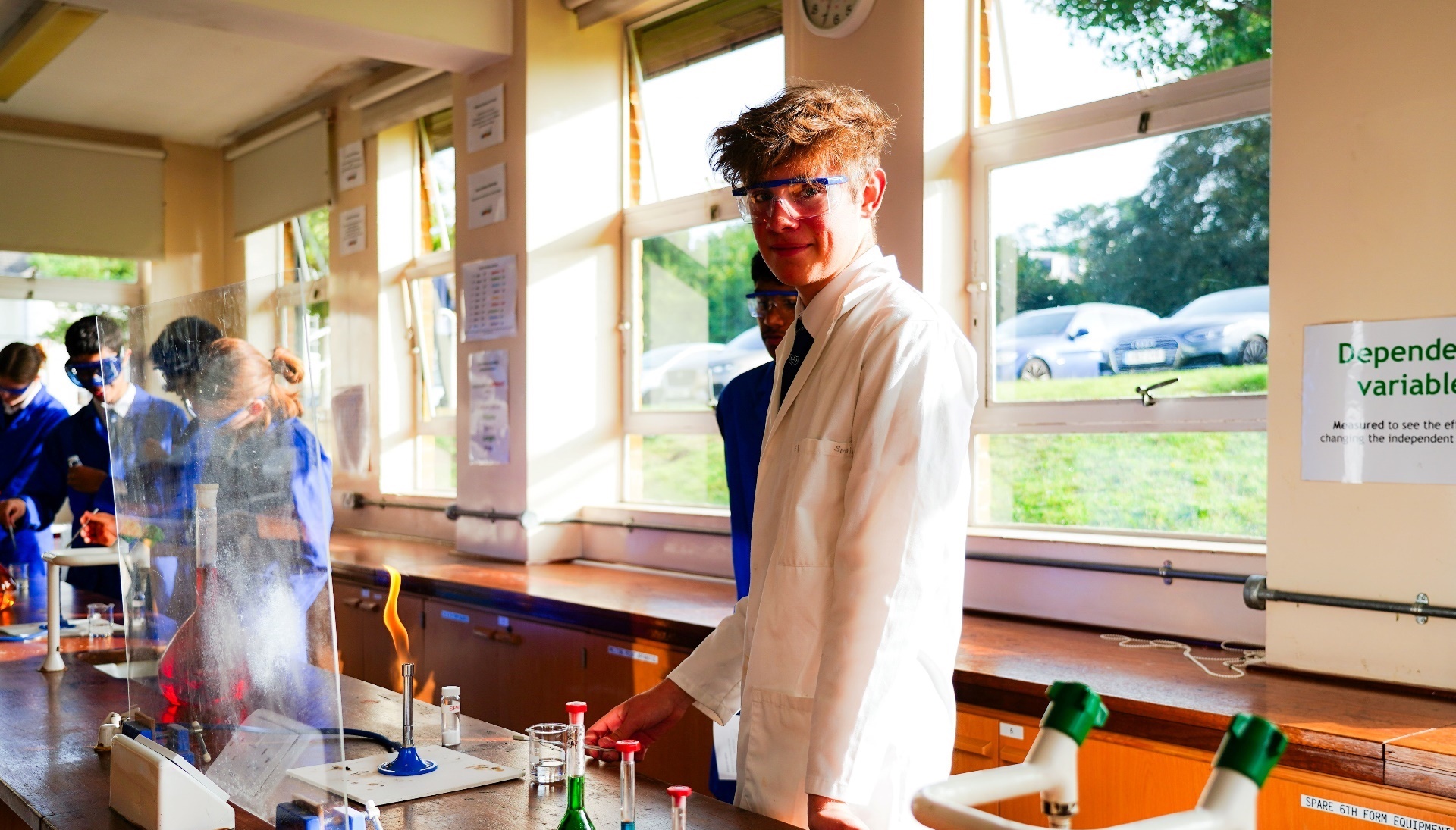
The sciences are amongst the most popular and successful subjects at Reigate Grammar School. All students study Biology, Physics and Chemistry up to the end of the Fifth Form (Year 11) and large numbers continue at least one of these to A Level. The sciences are also well represented in the courses students choose to follow at university: last year a quarter of our Upper Sixth leavers went on to study the sciences, engineering or medicine. All pupils in the First and Second Forms (Years 7 and 8) are taught general science using a bespoke in house course with the focus on stimulating topics and practical skills. Science week is an added highlight each year with activities to stimulate and challenge Lower School students. From the Third Form onwards, each of the three sciences are taught by subject specialists and students start the Edexcel IGCSE Chemistry course. This course culminates in the Fifth Form (Year 11) with their IGCSE examinations consisting of two written papers. In the Sixth Form, Chemistry is the most popular of the three sciences at RGS. There are usually four or five sets in each year of A Level study. Results at both GCSE and A Level continue to be excellent and, outside of lessons, the department promotes a regular series of lectures by the Royal Society of Chemistry, visits and clubs including the Top of the Bench competition, Chemistry Olympiad and Cambridge Chemistry Challenge. Please take a look at the Sixth Form pages for details of our A level Chemistry course
Classics at Reigate Grammar School is inspiring, diverse, and provides a wealth of opportunity to students. Latin is a language option available to all in the Lower School, taught using the Cambridge Latin Course, providing a rich and enjoyable introduction to the study of the ancient world. Many students then opt to continue with Latin to GCSE level. Greek is introduced as a GCSE subject in the Third Form with an opportunity to explore the literature, history, drama and mythology of the Ancient Greeks whilst also developing linguistic proficiency and skills. Classical Civilisation is also available to students as a GCSE option for those wishing to study the ancient world without a linguistic element or for those simply fascinated by the Greek and Roman civilisations! All three subjects are available to Sixth Form students at A Level and are seen as highly-regarded ways of demonstrating all-round academic and applied ability; in recent years students have gained places at Oxbridge to read Classics as well as Classical Archaeology and Ancient History. Beyond the classroom, there is much going on to enrich students’ experience, from classical reading competitions to re-enactments of ancient battles: visits to Roman villas and towns, theatre trips, set text study days and talks by University lecturers to name just a few. The department also boasts large overseas trips, taking groups of pupils to Italy or Greece on a rotational basis. Please take a look at the Sixth Form pages for details of our A Level Classics courses and follow our Twitter feed (@ClassicsRGS) for the latest updates
Computer Science is rapidly changing every aspect of the world we all live in. The best way to predict the future is to implement it. — David Heinemeier Hansson When our students leave university and look for their first job, many of them will be applying for roles that do not yet exist. A rounded education should help prepare them for this constantly evolving world. Studying Computer Science teaches students a range of invaluable life skills such as reasoning, logical thinking, problem solving, precision and resourcefulness. In the Lower School, the Computing curriculum is designed to enable students to develop computational thinking skills and become competent digital users. Students study a range of topics including programming, spreadsheets, binary, hexadecimal, computer hardware and networks. In the Upper School, Computer Science is a popular GCSE option subject. We offer two courses: Computer Science which is engaging and practical, encouraging creativity and problem solving. Students develop their understanding and application of the core concepts in computer science while also analysing problems in computational terms and devising creative solutions by designing, writing, testing and evaluating programs. Information and Communication Technology (ICT) develops lifelong skills which will be useful in students’ work across the curriculum and preparing them for future employment. They will develop understanding of the implications of technology in society, including social, economic and ethical uses and awareness of the ways ICT can help in home, learning and work environments. The syllabus combines theoretical and practical studies focusing on the ability to use common software applications to solve problems, including word processors, spreadsheets, databases, interactive presentation software, web browsers and website design. Students analyse, design, implement, test and evaluate ICT systems, ensuring that they are fit for purpose. At Sixth Form we offer Computer Science at A Level covering the core academic principles of computer science. Classroom learning is transferred into creating real-world systems through an independent programming project. Our A Level will develop both the students’ technical understanding and their ability to analyse and solve problems using computational thinking. We also offer the Cyber EPQ by CIISec, which is an unique Level 3 Cyber Security qualification, accredited by City & Guilds that has been developed to provide a starting point for anyone considering a career in Cyber Security. We are a small friendly department with a strong emphasis on offering a range of enrichment opportunities which include: Participation in a wide variety of national challenges and competitions e.g. the UK Bebras Computing Challenge, the TCS Oxford Computing Challenge, Alan Turing Cryptography competition, , VEX IQ Robotics and the British Algorithmics Olympiad. Trips to the Wired Next Generation conference, National Museum of Computing, Bletchley Park and the Computing LIVE conference. Weekly clubs including Creative Coders and RGS Robotics, where students have the opportunity to complete the BCS Level 1 Robotics Award. Please take a look at the Sixth Form pages for details of our A Level Computer Science course
In the Lower School (years 7 and 8) Drama is taught weekly and covers all aspects including, but not limited to, performing individually and in an ensemble, developing critical responses, directing, improvisation, staging, lighting and sound, set and costume design. The broad range of topics studied allows students to explore areas of interest whether on stage or behind the scenes. Each year the entire First Form will be involved in creating and performing an original piece of theatre in response to the stimulus: Dare to be Different. At GCSE level (years 9 to 11) students will work collaboratively developing their personal and group disciplines in devising, performing and interpreting theatre with the A Level course taking students further into the exploration of performance and text responses. The department runs a wide range of trips, clubs and extension activities for all year groups covering choreography, monologue, masterclasses and, of course, regular school productions. Headmaster’s scholarships are available for Drama for children entering the School at 11+ 13+ & 16+. More information is available on our Scholarships page. Please visit the Drama page and the Drama and Theatre Arts website for further information or visit the Sixth Form pages for details of our A Level Drama and Theatre course. Follow our Twitter feed (@RGSDrama) and Instagram (@RGSDrama) for the latest updates.
All pupils in the Lower School (Years 7 and 8) are taught two terms of Design and Technology and one term of Food Preparation and Nutrition in a carousel arrangement. Projects in the Lower School provide students with the skills in product design and manufacture to allow them a pathway to GCSE. Projects use varied contextual challenges thereby allowing students to develop their creativity and bring a sense of personality to their designing. Whilst manufacturing, students will learn the necessary skills to utilise CAD/CAM in their work. The A Level Product Design course combines theory and practice leading to an understanding of the entire design process including choice of materials, commercial viability, sustainability etc. The Design and Technology department is housed in an impressive purpose-built facility on the main school site. The design room has computers and an interactive whiteboard and there is access to three suites of computers in adjoining classrooms. The workshops are set up to cater for wood, metalwork and plastic. In addition to the traditional tools and machinery the department boasts a Laser Cutter, 3D Printer and CNC Router which enable students to manufacture their products to a very high standard. Weekly clubs allow students the opportunity to further develop their design ideas beyond the school curriculum. Please take a look at the Sixth Form pages for details of our A Level Product Design course
English is a thriving department within the school. Our teachers are passionate about literature and writing; we promote engaging and innovative teaching and learning where we constantly look for ways to bring texts to life and enthuse our students. The Lower School curriculum is broad covering fiction, non-fiction, poetry and an introduction to Shakespeare. Results in recent public examinations have been very pleasing at both GCSE and A Level with many students choosing to study English at university. We ensure that the practices of wider reading and independent study are established and maintained by students, especially those who go on to take English Literature in the Sixth Form. Each A Level English student is expected to attend one of our senior extra-curricular clubs and/or help with First Form English lessons or junior clubs. We also offer extension activities to those interested in taking English at degree level, such as shadowing literary prizes and entering poetry and essay competitions. Regular theatre visits, deep learning days and author visits are organised by staff and we celebrate National Poetry Day and World Book Day in style, varying our programme of events each year. Creative writing is keenly promoted, with work published online and creative responses displayed in classrooms and on the English noticeboard. We offer students the opportunity to enter national competitions, lunchtime clubs that explore wider literary concepts and the chance to engage with a wealth of literature which goes way beyond the curriculum. We work very closely with the School Library, and all Lower School classes have regular library lessons to encourage wider reading and research skills. Students are encouraged to bring their wider reading into the classroom and use it to complement their study. Sixth Form students also work with cultural institutions like The British Library and The National Poetry Library along with visiting speakers to develop their wider appreciation of the literary canon. Please take a look at the Sixth Form pages for details of our A Level English Literature course and follow our Twitter feed (@RGSEnglish) for the latest updates
Knowing how to choose and prepare healthy and nutritious food is a very important skill in life. Improving the health of the upcoming generation is vitally important, not only for the sake of individual students and their families but also for the sake of public health and budgets. The Food and Nutrition course here at RGS offers many valuable benefits to students. For example, the course will enable students to: Use food preparation equipment Learn different cooking techniques Follow a recipe Understand the health benefits and potential dangers of specific foods, nutrients, and additives Evaluate the contents in recipes and the ingredients listed on food packages Prepare and store food safely Take precautions to prevent foodborne illness Discover healthier ways to make their favourite foods while maintaining a food’s appealing taste Discover ways to buy healthy foods and ingredients cheaply Eat interesting foods that they haven’t tried before Eat foods from other cultures Develop an interest in creating new recipes Support their family’s health through diet All pupils will study Food and Nutrition in the Lower School as part of the DT carousel, comprising 11 week modules. Students can also participate in an after school cookery club where they have an opportunity to enhance their practical skills and further develop their love of cooking. GCSE students will undertake trips and masterclasses and all students are encouraged to participate in House Bake Offs and help our school charity ‘Loveworks’ who work with families experiencing food poverty.
Encouraging practical enquiry skills that underpin knowledge and understanding of geography. Geography is an academically robust subject which spans the social and physical sciences and promotes a lifelong interest and fascination in how the world works. A Level Geography is recognised by the Russell Group of universities as a ‘facilitating subject’ supporting applications for a range of undergraduate courses. Studying Geography helps us to understand many of the issues we face locally, nationally and globally, such as how we respond to the impact of climate change, how to prepare for natural hazards, or how we address inequality. Geographical research informs debate and helps us navigate through the world’s geographically complex people, places and environments. Geography is taught as a core subject in the Lower School using our own resources and booklets covering topics such as map skills, the UK, rivers and flooding, coasts, weather, crime, population and resources. Extensive use is made of technology to support learning. Geography at GCSE is a popular option with typically four or five sets in each year group and results are strong. For A Level, the teaching is broadly divided into human and physical topics and students regularly go on to win places to study Geography at some of the top universities in the country including Cambridge, Durham, Exeter, Manchester, Southampton and St Andrews. Fieldwork is a compulsory element for both GCSE and A Level. Recent trips have included a wide range of destinations including Brixton, Camber sand dunes, Norway (Sixth Form), Iceland (Third to Fifth Forms) and many local trips exploring features and developments in and around London and the South East. RGS is the first school in the country to be awarded the Met Office Metmark for quality of weather teaching. We have weather stations on the main school site and at our Hartswood playing fields, please visit the school’s weather site for the latest updates. Other opportunities beyond the curriculum include GeogSoc, a fortnightly meeting open to all students and covering topical debate and issues. Recent offerings from Sixth Formers and occasional outside speakers have included ethical sourcing of food, sustainable urban architecture and the spread of Covid-19. We were also fortunate to welcome Tim Marshall, author of Prisoners of Geography, to give a talk on Divided; why we are living in an age of walls.2020.08 Please take a look at the Sixth Form pages for details of our A Level Geography course and follow our Twitter feed (@GeographyRGS) for the latest updates
‘The past is another country.’ It is there to be explored and in that process we discover much about ourselves. At RGS we seek to stimulate student curiosity and interest in History through thoughtful enquiry and student focused learning. We aim to broaden and develop our understanding not just of the past but of the present and, in its turn, the future. This knowledge allows us to gain both insight and an enduring interest into who we are, where we come from and what we can achieve. Inside the classroom the style of teaching and learning across all years is creative and invigorating, and teachers deliver carefully planned, well focused lessons that employ a wide variety of teaching styles. These include debates, hot seating, presentations, video clips, recording by students themselves, common task assessments, essay writing, and source analysis. Lessons are designed to encourage active learning and independent thought. Our learning takes us beyond the classroom with visits to sites of historical significance such as Bodiam Castle, Hampton Court and the First World War battlefields. As part of the GCSE course we offer a trip to Berlin, and as part of the Advanced Level course there is the opportunity to participate in a combined trip with Politics to New York and Washington. We have a History reading group, and a History and Politics society, both of which meet weekly, and the latter involves presentations by both staff and students, as well as guest speakers. A significant number of students go on to read History, Politics, or combined honours courses at top universities. The department has also enjoyed regular success at Oxbridge. Please take a look at the Sixth Form pages for details of our A Level History course and follow our Twitter feed (@History_RGS) for the latest updates.
Mathematics is a vital tool in our increasingly technical world. First Form students are taught in mixed ability groups and subsequently in bands from the Second Form (Year 8) onwards, usually with one more class than the number of forms. The more able mathematicians are invited to study Further Mathematics GCSE in Fifth Form and Statistics is available as a GCSE option. The Lower School curriculum is broad and makes good use of technology – e.g. Hegarty maths to introduce an element of fun whilst building strong foundations for the GCSE course. Students are encouraged to take part in cipher challenges, competitions and cross curricular activities and outreach programmes. Upper School students will cover the GCSE course across three years (Years 9 to 11) with regular reviews of topics studied. Students have the opportunity to attend a variety of exciting talks within and outside of school, extending their interest and knowledge of Mathematics far beyond the classroom. Students are very successful when taking part in local and national Maths competitions including the UK Maths Challenges and Olympiads, Hans Woyda, the Surrey Schools Maths Challenge and Team Challenges. Mathematics is a very popular choice in the Sixth Form making us the largest subject at that level. Students achieve strong results leading to offers in a wide range of subjects at some of the best universities in the country. Please take a look at the Sixth Form pages for details of our A Level Maths and Further Maths courses
The ability to communicate in another language will be a key factor for success in the career market of the 21st Century. We are passionate about giving our students an insight into, and an appreciation of, the cultures of the countries where their chosen languages are spoken as well as building solid foundations for them to speak and understand these languages. All students in the Lower School study up to three languages, choosing between French, Spanish, German, Mandarin and Latin. One or two languages may then be taken through to GCSE at which point Greek is added as an option. All European languages plus Latin and Greek are offered at A Level. We run a variety of weekly clubs and extension activities including a weekly Junior Culture club with an enviable attendance, French lunch and Spanish chat, and we enter students for a variety of language related competitions including the French Spelling Bee, the Stephen Spender Poetry Translation Competition and university essay competitions. Examination results over recent years have been excellent with many students choosing to continue a language at university, including at Oxford and Cambridge. Language teaching is carried out for the most part in the target language in all years. Students from Third Form to Upper Sixth have regular sessions with our Foreign Language Assistants. There are internal written examinations, aural tests and oral tests on a regular basis. We see visits abroad as an extension of our classroom work. These visits are arranged for many year groups, whether as work experience, homestays, cultural visits or exchanges. Yearly visits to Spain include a Fourth Form exchange and a Second Form visit to southern Spain; visits to Germany include Berlin and an exchange in Aachen, while visits to France include a Fourth Form exchange with a school near Lille, a First Form trip to northern France and where possible a Second Form day trip to our partner school near Lille, combined with letter exchanges throughout the year. Sixth Form students are encouraged to take part in work experience and/or study trips abroad. Please take a look at our Sixth Form pages for details of our A Level language courses
RGS is well known for its strong musical tradition which begins in the classroom and extends through numerous extra-curricular opportunities. In the Lower School, students will study music as part of the core curriculum with timetabled lessons each week. The topics studied are many and varied and will introduce students to all aspects of musical life including the use of technology in music. The curriculum covers composition, analysis, exploration of the instruments in an orchestra, vocal games, musical theatre, music in film, music through the ages and much more besides. In the Upper School the GCSE curriculum further develops performance, composition and analysis skills building a strong foundation for success at GCSE and on towards A-Level. Students will deepen their understanding of melody and harmony, they will appraise music through both practical and academic analysis and learn to write using musical terminology. Performance is a key part of the GCSE course, please take a look at the course guides for further details. Students have many opportunities to participate in the musical life of the school, please see our extra-curricular music page for further details. There is a wide range of choirs, ensembles and orchestras available and many trips to concerts and other performance opportunities throughout the year. Please take a look at news and events and follow our Twitter feed (@rgs_music) for the latest updates. Please take a look at the Sixth Form pages for details of our A Level Music and Music Technology course
Students with an enthusiasm and passion for photography and the creative process will love this course. Investigation, analysis, experimentation and exploration form the backbone of this course and encourage students to develop their inquiring minds and independence. Photography GCSE is driven by theme based projects which contribute to each student’s personal portfolio which, in turn, contributes to 60% of the overall grade awarded. Students are gradually introduced to a broad range of materials and processes. They will learn to use both digital and analogue cameras and to use the darkroom along with programmes such as Photoshop. Please take a look at the Sixth Form pages for details of our A level Art and Photography courses or follow our Twitter feed (@ArtDeptRGS) for the latest updates
PE is taught as a core subject to all pupils from First Form to Fifth Forms (Years 7-11). All students have one afternoon of games each week plus a separate PE lesson. Boys and girls are taught together in First and Second Form and then offered separate options in Third and Fourth Form. In Fifth Form, PE lessons move to focus on well-being. The aim is to promote sport for all and provide an opportunity to access a wide range of activities which vary from First Form through Fifth Form. The major sports for boys are rugby, hockey, cricket, tennis and athletics. For girls, the major sports are hockey, netball, rounders, tennis and athletics. Further options are available for older students, including soccer, squash, badminton, swimming, spinning, and fitness training. We run a large number of teams in the traditional sports and provide opportunities for all students to be involved, regardless of their ability. Most fixtures are played on Saturdays, with occasional midweek matches. The school has a long tradition of overseas sports tours, and recent destinations have included Biarritz, Jersey, Barcelona, Holland, Dubai and South Africa. The facilities at RGS are excellent with 32 acres of playing fields at our Hartswood sport ground (located two miles from the school) along with two floodlit all-weather astroturf pitches. On the main school site the department has use of a dedicated sports hall, 25m 4-lane indoor swimming pool, dance studio, fitness room, and four floodlit netball courts. Optional after school clubs are run for all year groups to allow students of all abilities the opportunity to train, improve in and enjoy their sport. Holiday camps, run during the longer school holidays, are also very popular. Scholarships Sport scholarships are available for children entering the School at 11+, 13+ and 16+, further information is available on our Scholarships page. Academic PE The department offers GCSE and A Level Physical Education along with BTEC Sport. All three courses introduce students to a wide range of disciplines and topics such as sports psychology, injury management, movement analysis, anatomy and physiology, fitness and nutrition etc. Please see the course choice booklets for up to date curriculum information. Please take a look at the Sixth Form pages for details of our A Level and BTEC sports courses and follow our Twitter feed (@RGSSport) for the latest updates
The sciences are amongst the most popular and successful subjects at Reigate Grammar School. All students study Biology, Physics and Chemistry up to the end of the Fifth Form (Year 11) and large numbers continue at least one of these to A Level. The sciences are also well represented in the courses students choose to follow at university: last year nearly a quarter of our Upper Sixth leavers went on to study the sciences, engineering and medicine. All students in the Lower School (Years 7 and 8) are taught general science using our bespoke programme of study with an emphasis on the acquisition of relevant skills. From the Third Form onwards, each of the three sciences are taught by subject specialists and students begin their GCSE courses. All three sciences are available at A Level, either individually or in combination with a wide range of other subjects. Physics at RGS Physics remains a popular choice at RGS with, typically, four sets at A level. Students benefit from a dedicated team of teachers with a wide range of specialties across Physics and Engineering. The department has been very successful in public exams in recent years. Furthermore, pupils regularly achieve awards in the challenging BPhO competitions. Many students go on to study related subjects at university and we have had particular success with applications for Physics and Engineering. Please take a look at the Sixth Form pages for details of our A Level Physics course
In a world that is sometimes united, yet often divided, by religious belief the department aims to educate pupils on the variety of religious faiths and to explore both their historical influence and what motivates believers today. We pride ourselves in offering the opportunity for students to delve into questions about truth and morality, and to develop meaningful opinions about the world around them. Theology and Philosophy is a core subject in the Lower School (Years 7 and 8). In the First Form pupils are introduced to two of the three Abrahamic religions in chronological order, beginning with Judaism, followed by Christianity. In the Second Form we introduce Philosophy through the comparison of Eastern and Western religious understanding of the world. We then focus on current ethical issues including religious conflict and religious identity as well as studying the third Abrahamic religion, Islam. Pupils will choose their GCSE options at the end of the Second Form. The GCSE course is very popular and addresses issues of current debate ranging from philosophical questions over the existence of God and religion versus science through to ethical issues such as abortion, euthanasia, war, poverty and sexual ethics. Pupils enjoy the opportunity to debate important philosophical and ethical issues and apply their understanding of both Christian and Islamic viewpoints to key questions, as well as exploring non-religious and secular responses. The A Level course develops a greater understanding and appreciation of religious beliefs and teachings, as well as probing the disciplines of ethics and philosophy of religion. Students will develop their skills of critical analysis in order to construct balanced, informed arguments and responses to religious, philosophical and ethical ideas. Typically, this attracts two sets of students in each of the year groups and pupils often choose to continue this subject at university. The department offers extra clubs to inspire pupils in their studies of Theology and Philosophy. Fifth and Sixth Form pupils present and debate on a range of topics in The Academy, a current affairs debating club that attracts pupils from across a wide range of disciplines and a Christian Union club runs weekly for all age groups. The department also organises enrichment trips including a trip to Oxford and Philosophy and Ethics conferences for Sixth Form pupils in London. Please take a look at the Sixth Form pages for details of our A Level Theology and Philosophy cours